WebAssembly Component Model Explained
WasmHub Team
March 26, 2025 · 8 min read
Classic WebAssembly modules are islands. They communicate with the outside world through a narrow channel of i32, i64, f32, and f64 values passed over linear memory. Passing a string requires agreeing on an encoding, a length convention, and who allocates and frees the buffer. Linking two modules together requires writing glue code that neither module knows about. Distributing a module for others to use requires shipping language-specific wrapper libraries alongside it.
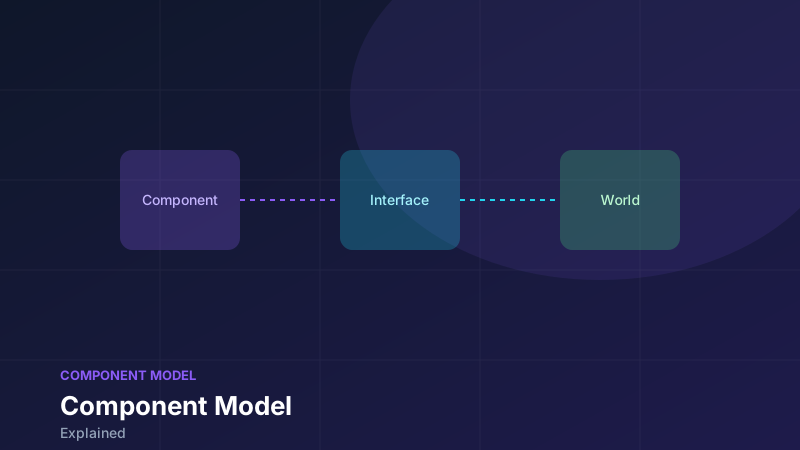
The WebAssembly Component Model solves all of this. It's a layered specification that adds a rich type system on top of core Wasm, defines a standard interface description language (WIT), and specifies a binary format for composable, self-describing modules. Understanding it is key to following where the Wasm ecosystem is heading.
The Problem the Component Model Solves
To see why the Component Model matters, consider a concrete scenario: you've written an image compression library in Rust and you want to distribute it so that Go, Python, and JavaScript developers can use it without knowing any Rust.
With classic Wasm, you'd need to:
- Compile the Rust to a
.wasmfile - Write a JavaScript wrapper that speaks the raw function/memory ABI
- Write a different Go wrapper
- Write a different Python wrapper
- Document the calling convention (how strings are passed, who owns which memory, what error values mean)
- Repeat this maintenance burden every time the API changes
With the Component Model:
- Describe the API in WIT — one file, one source of truth
- Compile the Rust to a component — a self-describing
.wasmbinary that embeds the WIT description - Use
wit-bindgento generate type-safe host-language bindings from that WIT description — automatically, for any supported language
The component itself becomes a distribution unit, like an npm package or a crate, but language-agnostic at the binary level.
WIT: WebAssembly Interface Types
WIT (WebAssembly Interface Types) is the IDL (interface definition language) of the Component Model. If you've used Protobuf, Thrift, or CORBA IDL, the concept is familiar — but WIT is designed specifically for Wasm's ownership model and type system.
// image-compressor.wit
package wasmhub:image-compressor@1.0.0;

/// The primary interface exposed by this component
interface compress {
  /// Supported output formats
  enum format {
    webp,
    avif,
    jpeg,
  }

  /// Options for the compression operation
  record options {
    format: format,
    /// Quality from 0 (worst) to 100 (best)
    quality: u8,
    /// Strip EXIF and ICC metadata if true
    strip-metadata: bool,
  }

  /// Error cases with descriptive variants
  variant compress-error {
    invalid-input(string),
    unsupported-format(format),
    internal(string),
  }

  /// Compress raw RGBA pixel data into the requested format.
  /// Returns the encoded bytes or an error.
  compress-rgba: func(
    pixels: list<u8>,
    width: u32,
    height: u32,
    opts: options,
  ) -> result<list<u8>, compress-error>;
}

/// What this component exports to the outside world
world image-compressor {
  export compress;
}
WIT supports: bool, u8–u64, s8–s64, f32, f64, char, string, list<T>, option<T>, result<T, E>, tuple<T...>, record (struct), variant (tagged union), enum, flags (bitflags), and resource (handle to an opaque object with methods). This type system is rich enough to express any API you'd write in a normal language.
Building a Component in Rust
cargo-component is the standard tool for building Wasm components from Rust. It wraps cargo and handles the component model compilation and wit-bindgen code generation automatically.
cargo install cargo-component
cargo component new image-compressor --lib
This creates a project with a wit/ directory and a Cargo.toml pre-configured for component output. Drop your WIT file into wit/world.wit, then implement the generated trait:
// src/lib.rs
// cargo-component generated this trait from the WIT definition
use exports::wasmhub::image_compressor::compress::{
    CompressError, Format, Guest, Options,
};

struct Component;

impl Guest for Component {
    fn compress_rgba(
        pixels: Vec<u8>,
        width: u32,
        height: u32,
        opts: Options,
    ) -> Result<Vec<u8>, CompressError> {
        if pixels.len() != (width * height * 4) as usize {
            return Err(CompressError::InvalidInput(
                "pixel buffer size doesn't match dimensions".into(),
            ));
        }

        match opts.format {
            Format::Webp => encode_webp(&pixels, width, height, opts.quality),
            Format::Avif => encode_avif(&pixels, width, height, opts.quality),
            Format::Jpeg => encode_jpeg(&pixels, width, height, opts.quality),
        }
    }
}

wasmhub::image_compressor::compress::export!(Component with_types_in wasmhub::image_compressor::compress);
Build the component:
cargo component build --release
# Produces: target/wasm32-wasip2/release/image_compressor.wasm
This .wasm file is a component — it embeds the WIT definition, the type information, and the implementation. Any conforming runtime can inspect it and know exactly what it exports and imports.
Consuming a Component from JavaScript
jco (JavaScript Component Tools) is the npm package that makes consuming Wasm components from JavaScript straightforward. It can transpile a component to a pure JavaScript + Wasm bundle:
npm install -g @bytecodealliance/jco
jco transpile image_compressor.wasm -o ./generated
This generates a fully-typed JavaScript module:
// generated/image_compressor.js (auto-generated — do not edit)
export { compressRgba } from './internal.js'
// your-app.js
import { compressRgba } from './generated/image_compressor.js'
const pixels = new Uint8Array(width * height * 4) // your RGBA data
// ...fill pixels...
const result = compressRgba(pixels, width, height, {
format: 'webp',
quality: 85,
stripMetadata: true,
})
if (result.tag === 'ok') {
const blob = new Blob([result.val], { type: 'image/webp' })
// ...
} else {
console.error('Compression failed:', result.val)
}The JavaScript side gets a typed interface that mirrors the WIT definition exactly. No Module._malloc, no HEAPU8, no manual null-termination.
Composing Components Together
The real power of the Component Model is composition: linking components together at the binary level, wiring one component's exports to another's imports, without writing any glue code.
Imagine a pipeline: a csv-parser component that exports parse, and an image-compressor component that imports parse to read image metadata from CSV files. wasm-tools compose can wire them together:
wasm-tools compose \
  image-compressor.wasm \
  --def csv-parser.wasm \
  -o pipeline.wasm
The output is a single .wasm component that contains both modules, internally linked. From the outside it looks like one component with one interface. No runtime plugin system, no dynamic loading, no shared state — just static composition verified at link time.
// The composed component's world (inferred automatically)
world pipeline {
  // csv-parser's import (raw bytes in) is satisfied internally
  // image-compressor's export is what the outside world sees
  export compress;
}
Resources: Object-Oriented Handles
WIT resource types deserve special mention. They represent opaque, reference-counted handles to objects that live inside the component, with methods attached:
interface decoder {
  resource png-decoder {
    // Constructor
    constructor(data: list<u8>);
    // Methods
    width: func() -> u32;
    height: func() -> u32;
    decode-row: func(y: u32) -> list<u8>;
  }
}
This maps naturally to a class in JavaScript, a struct with impl in Rust, and an object in Python. Resources are automatically dropped (and their Wasm memory freed) when the handle goes out of scope on the host side, following the ownership rules of the host language. This solves one of the most error-prone aspects of classic Wasm interop: manual memory management across the boundary.
The Tooling Ecosystem
| Tool | Purpose | Current version (2026-06-16) |
|---|---|---|
cargo-component | Build Wasm components from Rust | v0.21.1 |
wit-bindgen | Generate bindings from WIT for Rust, C, Go, JS | v0.58.0 |
jco | Transpile and run components in JavaScript/Node.js | v1.24.1 |
wasm-tools | Inspect, validate, compose, and transform components | v1.252.0 |
wasmtime | Run WASI components with full component model support | v45.0.2 |
componentize-py | Build components from Python | — |
componentize-dotnet | Build components from C# / .NET | — |
The Component Model is now the default in the major runtimes — Wasmtime, Wasmer, Jco, and Spin — and has been production-standard since WASI 0.2 stabilized on 2024-01-25. First-class language coverage is strongest for Rust and JavaScript, with Python, Go, C#, and C following close behind. (For reference: the old warg registry was archived in July 2025 — the community has since moved to OCI-based packaging via wasm-pkg-tools, so components can publish to any OCI-compliant registry like GHCR, Docker Hub, or Harbor.)
What's Next: WASI 0.3 (2026-06-11)
WASI 0.3 was ratified on 2026-06-11. Its headline change is native async: components now export and import async func(...) directly, with stream<T> and future<T> as first-class types — replacing the start-foo / finish-foo / subscribe dance from 0.2. Wasmtime 46 will ship 0.3 enabled by default, and jco already supports the full 0.3 surface. The path to a Component Model 1.0 spec is now on the explicit Bytecode Alliance roadmap.
Why This Matters
The Component Model fundamentally changes what "distributing a WebAssembly module" means. Instead of shipping a binary that requires per-language wrapper libraries and undocumented calling conventions, you ship a self-describing component with a machine-readable interface. Consumers generate their own bindings. Composition happens at the binary level. Security boundaries are enforced by the component boundary, not by runtime checks.
It's the realization of a long-standing promise: write code once, in any language, and have it run — interoperably — everywhere WebAssembly runs. That's a big deal.