WebAssembly vs JavaScript: When to Use What
WasmHub Team
February 5, 2025 · 6 min read
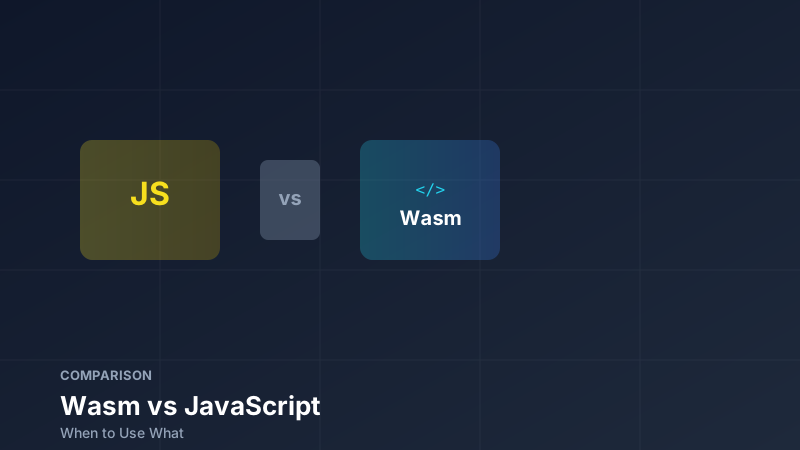
JavaScript has ruled the web for three decades. WebAssembly arrived in 2017 as a potential usurper — but the reality is far more nuanced than the hype suggests. These two technologies are designed to work together, not to replace each other. Understanding where each one shines will help you make better architectural decisions.
How Each Runtime Actually Works
JavaScript is a dynamic, JIT-compiled language. V8, SpiderMonkey, and JavaScriptCore all spend significant effort optimizing hot code paths at runtime through techniques like hidden classes, inline caching, and tiered compilation. For most code, this produces very fast results — often within 2–3× of native speed for number-crunching tasks.
WebAssembly takes a different approach. It's a compact binary instruction format that acts as a compilation target. Your source code (Rust, C++, Go, or dozens of other languages) gets compiled ahead-of-time into a Wasm binary. The browser doesn't need to parse, interpret, or speculate — it validates the binary, compiles it to machine code, and runs it. Startup is predictable and performance is consistent with no JIT warm-up tax.
// JavaScript — the JIT kicks in after several iterations of a hot loop
function fibJS(n) {
  if (n <= 1) return n
  return fibJS(n - 1) + fibJS(n - 2)
}

// The equivalent in Rust compiled to Wasm runs at consistent throughput
// from the very first call — no profiling overhead, no deoptimization risk
// pub fn fib(n: u32) -> u32 {
//   if n <= 1 { return n }
//   fib(n - 1) + fib(n - 2)
// }
For a tight computational loop run millions of times, the difference can be dramatic. Wasm typically wins on sustained throughput; JavaScript is often faster for small one-off operations because there's no cross-boundary overhead.
The Hidden Cost: Crossing the Bridge
Here's what textbook benchmarks don't show: every call across the JavaScript/WebAssembly boundary has a cost. Values must be marshalled, shared memory may need synchronization, and the engine must switch contexts. For functions called thousands of times per frame, this overhead can easily swamp any speed gains from the Wasm module itself.
This means the common pattern of "just port this one slow function to Wasm" doesn't always pay off. The sweet spot is workloads where:
- A large chunk of work happens entirely inside the Wasm module
- The module is called infrequently relative to its internal computation
- Data is passed via
SharedArrayBufferor pre-allocated linear memory rather than as individual copied arguments
When to Reach for WebAssembly
CPU-intensive algorithms. Image processing, video encoding, audio DSP, cryptography, physics simulations, and ML inference are natural fits for Wasm. Figma's rendering engine, Google Earth's terrain pipeline, and ffmpeg.wasm's media processing all live here. These are workloads that would make a JavaScript profiler cry.
Porting existing native libraries. Have a battle-tested C library for PDF parsing, LZ4 compression, or 3D mesh operations? Emscripten or wasm-bindgen can bring it to the browser without a full rewrite. You inherit decades of optimization for free.
Predictable latency. Because Wasm doesn't have a JIT warm-up phase or stop-the-world garbage collector pauses (unless your source language has one), it's easier to hit consistent frame-time budgets in real-time applications like games, audio worklets, and video pipelines.
Security-sensitive sandboxing. Wasm's linear memory model and capability-based security make it excellent for running untrusted plugins or user-submitted code safely. WASI extends this with a fine-grained filesystem and network permission model.
When JavaScript Is the Better Choice
Anything touching the DOM. WebAssembly has no direct DOM access. Every UI operation requires a round-trip through JavaScript. For typical web apps — event handlers, form validation, API calls, and state management — JavaScript is both faster to write and faster to run because you eliminate the bridge entirely.
Rapid iteration and prototyping. TypeScript, Vite, and the npm ecosystem give you an unmatched developer experience. Hot module replacement, inline debugging, and millions of packages make JavaScript the right call when shipping speed matters more than runtime speed.
Small utility functions. If the operation completes in under a millisecond anyway, bridge overhead will cost you more than you gain. Profile before you port.
Teams without systems-programming experience. Rust, C++, and Go have steep learning curves. If your team doesn't already know these languages, the productivity cost of adopting Wasm may outweigh the performance gains — at least until AssemblyScript matures as an approachable middle ground.
A Practical Interop Pattern
The most effective production integrations treat the Wasm module as a black box that JavaScript orchestrates. The key is minimizing boundary crossings by doing bulk work inside the module:
// Load and instantiate once at app startup
const { instance } = await WebAssembly.instantiateStreaming(
  fetch('/wasm/image-processor.wasm'),
  { env: { memory: new WebAssembly.Memory({ initial: 16 }) } }
)

const { processFrame, alloc, dealloc } = instance.exports

// Pass an entire frame via shared linear memory — one call, not per-pixel calls
function applyFilter(imageData, width, height) {
  const ptr = alloc(imageData.byteLength)

  // Write into Wasm linear memory directly
  new Uint8Array(instance.exports.memory.buffer, ptr, imageData.byteLength)
    .set(new Uint8Array(imageData.data.buffer))

  processFrame(ptr, width, height)

  // Read result back
  const result = new Uint8ClampedArray(
    instance.exports.memory.buffer.slice(ptr, ptr + imageData.byteLength)
  )

  dealloc(ptr, imageData.byteLength)
  return new ImageData(result, width, height)
}
One alloc, one processFrame, one dealloc — not thousands of per-pixel boundary crossings. This pattern consistently yields 10–100× better throughput than naively calling small Wasm functions in a loop.
Making the Call
The decision usually comes down to three questions:
- Is the workload compute-bound? If yes, Wasm is worth evaluating.
- Can the heavy work happen entirely inside the module? If you'd be crossing the boundary in a hot loop, reconsider.
- Do you have (or want to learn) a systems language? If not, the DX cost may negate the runtime gains.
WebAssembly doesn't replace JavaScript — it replaces native plugins, Flash, and the need to rewrite C/C++ libraries from scratch. The most powerful applications combine both: JavaScript for orchestration, user interaction, and the DOM; Wasm for the CPU-intensive kernels that JavaScript would struggle with. Think of it less as a competition and more as a highly productive division of labor.